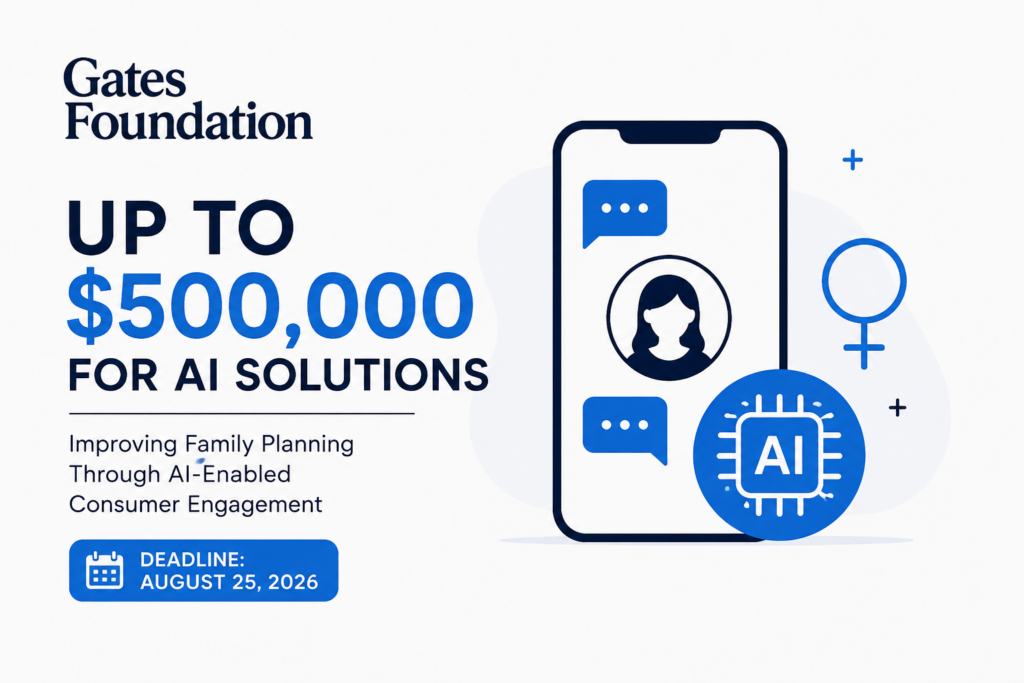

Could your technology solution qualify for up to US$500,000 from the Gates Foundation? If you are a young founder, technology entrepreneur, researcher or organization working on digital health, artificial intelligence or consumer engagement, there is a funding opportunity you may want to look at before the deadline passes. The Gates Foundation has opened a funding opportunity offering up to US$500,000 per project for organizations developing AI enabled consumer engagement solutions that can improve family planning.
The funding comes through the Grand Challenges initiative and is designed around a specific question: Can artificial intelligence help people access better family planning information and make more informed decisions about contraception?
Successful projects can receive up to US$500,000 for a period of up to 12 months. And the opportunity is not limited to traditional nonprofits. The Gates Foundation says eligible applicants can include nonprofit organizations, for profit companies, international organizations, government agencies and academic institutions. Partnerships between different types of organizations are also encouraged. But there is an important catch. This is not a funding opportunity for someone who simply has an interesting AI idea. The foundation wants organizations that already have users, an existing consumer engagement intervention and the ability to test an AI enabled solution in the real world. That makes this particularly interesting for organizations that have already built something and now n eed funding to take it further.
Why is the Gates Foundation interested in AI?
The problem behind this opportunity is much bigger than technology. According to the World Health Organization, approximately 164 million women of reproductive age globally have an unmet need for contraception. The situation is particularly challenging in some regions, where access to family planning information and services remains limited.
Technology could potentially help close some of those gaps. Someone may have questions about contraception but feel uncomfortable asking them face to face. Someone living far from a health facility may struggle to access reliable information. Another person may need information in a local language. Someone else may want to understand their options privately before deciding whether to visit a healthcare provider. This is where AI enabled consumer engagement comes in.
The Gates Foundation is interested in solutions that can provide more personalized interactions instead of simply sending users the same automated message. The goal is not to build another chatbot just because AI is fashionable. The foundation wants to know whether these technologies can actually improve outcomes such as contraceptive uptake, continuation and informed method choice. That means an impressive demonstration alone will not be enough. Your technology needs to solve a real problem. And you need to have a way to measure whether it works.
Who Can Apply for the Gates Foundation Funding?
This is where you need to slow down and read the eligibility requirements carefully. The opportunity is open to several types of organizations, including for profit companies, nonprofits, academic institutions, government agencies and international organizations. However, the current challenge focuses on nine countries: Nigeria, Ethiopia, the Democratic Republic of Congo, Tanzania, Senegal, Niger, Kenya, South Africa and Côte d’Ivoire.
Applicants also need to have an existing consumer health, women’s health or family planning intervention and an established user base or distribution relationship in at least one of the target countries. This requirement is significant. You do not necessarily need an existing AI family planning platform. But you should already have something that reaches people. For example, you might operate a digital health platform with an established user base. Perhaps your organization already provides health information through a mobile application. Maybe you work with healthcare providers or telecommunications companies. You could even have an existing consumer engagement programme that could be enhanced with AI. The important thing is that you are not starting from zero.
The Gates Foundation wants applicants to have the infrastructure, relationships and experience needed to actually deploy and evaluate the proposed solution. That also means this may not be the right opportunity for someone who has only an idea and no prototype, users or existing intervention and that’s okay.
One of the biggest mistakes young entrepreneurs make is applying for every funding opportunity they find. You don’t need every opportunity; you need the right opportunity.
If you are still looking for funding opportunities that fit your stage, Lantern Post has also covered funding opportunities for entrepreneurs and innovators as well as the WFP Agricultural Innovation for Climate Resilience Programme. Those posts can help you compare different opportunities rather than applying blindly.
The Gates Foundation wants evidence, not AI hype
This could be the most important part of the application. Don’t tell the Gates Foundation that your AI system is revolutionary. Show them it is. The challenge asks applicants to measure things such as the quality of AI interactions, user engagement and outcomes following interaction with the technology.
The foundation is particularly interested in whether these interventions can influence outcomes related to contraceptive uptake, continuation and informed choice. So, imagine you already operate a digital health platform. You could potentially propose adding an AI enabled conversational feature that helps users find reliable, personalized information. But your proposal should go much further than: “We will build an AI chatbot for family planning.”
Instead, explain what you already have. You might say that your platform already reaches a particular number of users. You might explain what those users currently need. Then explain what AI will add. Then explain how you will test it. And finally, explain how you will measure whether it actually improves outcomes. That creates a much stronger story.
Follow this format:
Existing problem → existing users → proposed AI solution → implementation → measurement → measurable impact.
The foundation also says information generated by AI should be based on vetted, locally relevant family planning information aligned with national Ministry of Health or WHO guidance. That is particularly important because this involves health information. You cannot simply build a chatbot and allow it to generate whatever answer sounds convincing.
Important Note:
You don’t have to build everything from scratch. The Gates Foundation does not require applicants to already have a fully proven AI solution. Instead, it is interested in organizations that already have an existing consumer engagement approach and can introduce and evaluate an AI component.
That opens the door to organizations working in related areas. Imagine a women’s health platform that currently communicates with users through an app, website or call centre. The organization could introduce an AI system to make those interactions more personalized. Or imagine a company that already has relationships with healthcare providers and wants to develop an AI powered information service. The existing infrastructure becomes the foundation.
The funding can then help develop, test and evaluate the new technology. That is much more realistic than trying to build an entire company, user base and AI system in 12 months. And if you are preparing your first serious funding proposal, don’t underestimate the importance of how you present the idea.
A good technology does not automatically make a good funding application. You still need to explain the problem, your solution, your users, your implementation plan, your budget and the results you expect to achieve. If proposal writing is one of your weak areas, you can browse grant writing and proposal writing books on Amazon.
How much Money Will you Receive?
The headline figure is US$500,000 per project. The funding period can last for up to 12 months.The Gates Foundation says budgets should be appropriate to the proposed work. Indirect costs may also be included, subject to the foundation’s policies, with the current challenge allowing indirect costs up to 15% of the total budget.
But don’t automatically ask for $500,000 simply because that is the maximum. If your project can be properly implemented for $250,000, your budget should explain why. A strong budget should tell the same story as your technical proposal.
If you are testing an AI system with 100,000 users, for example, the foundation should be able to understand how the requested funding relates to development, deployment, staffing, safety, monitoring and evaluation. The numbers need to make sense. And remember, this is not simply about building software.
The foundation wants to understand whether the technology can produce meaningful results. That means your proposal should clearly identify the outcomes you intend to measure.
The Deadline
This is one reason you should not leave this opportunity sitting in your bookmarks. The current challenge opened on July 21, 2026, and applications close on August 25, 2026 at 11:30 a.m. Pacific Time. The Gates Foundation has provided supporting documents, application instructions, FAQs and other information to help applicants understand the requirements. There was also a dedicated information webinar on August 4, 2026.
If your organization appears to qualify, start by checking the requirements rather than immediately writing the proposal.
Ask yourself:
- Do we already have users?
- Do we operate in one of the eligible countries?
- Do we already have a consumer engagement intervention?
- What exactly would AI add?
- Can we measure whether it works?
- Do we have the technical capacity to implement it?
- Can we protect users and provide reliable health information?
If the answers are mostly yes, you may have a strong reason to apply. Read the official Gates Foundation challenge and full requirements here. You can also go directly to the Gates Foundation application portal.
Don’t wait until the final day. Funding applications often require information from several people within an organization. You may need financial information from your finance team. Technical information from developers. Impact data from programme staff. And evidence from the people who actually use your product.
Giving yourself time to bring those pieces together can make a huge difference.
Final Thoughts
The most interesting thing about this opportunity isn’t necessarily the headline number. It is what the funding could help an organization prove. The Gates Foundation is part of the wider Grand Challenges network, which says it has supported more than 2,500 innovation projects across more than 90 countries since 2004.
That is a significant ecosystem for innovators. And for a young founder or technology organization, successful funding can provide more than money.
- It can provide an opportunity to test an idea in the real world.
- It can generate evidence.
- It can help you understand your users better.
- It can demonstrate that your technology produces measurable results.
- And that evidence can become extremely valuable when you approach future funders, partners or investors.
Don’t apply simply because you saw “$500,000” in a headline. Apply because your existing work genuinely fits the problem the Gates Foundation is trying to solve. If you are eligible and already have the users, technology and infrastructure needed to test your solution, this could be a serious opportunity. If you only have an idea, don’t force it. Build the prototype, find users, test the technology, learn what works and what doesn’t then look for funding that matches your stage.
Lantern Post may earn a commission from qualifying purchases made through some links in this article. This does not affect the price you pay.