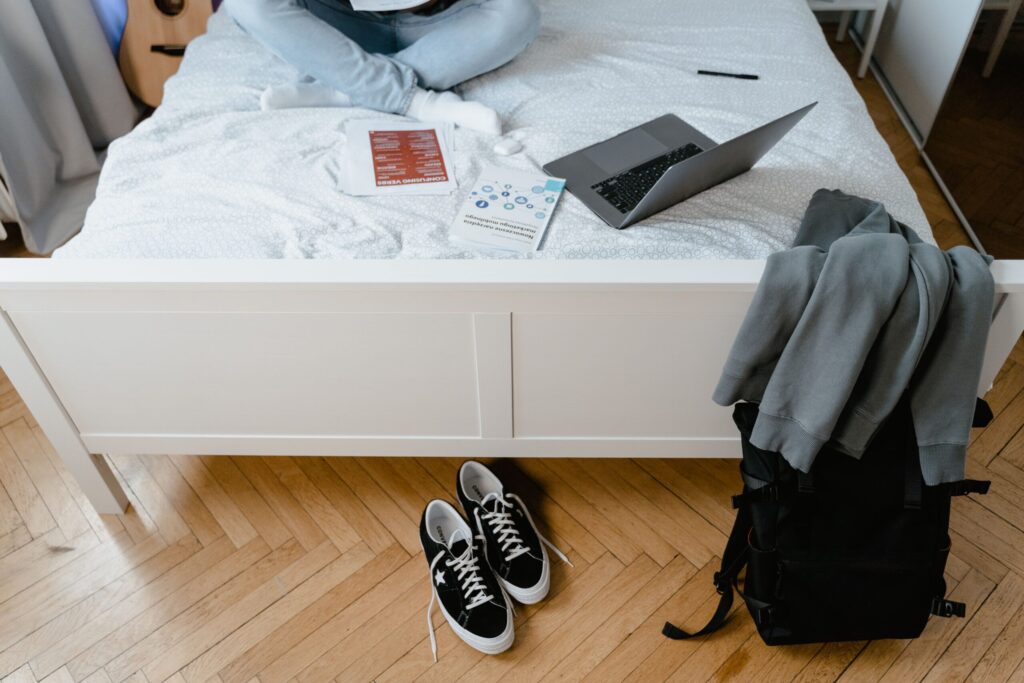

Nobody ever tells you that the most stressful part of studying abroad is not the visa application, the scholarship interview, or even leaving your family behind. It is standing in your bedroom three days before your flight staring at an open suitcase and realising you have absolutely no idea what you actually need.
This guide fixes that problem. Whether you are heading to the UK, Germany, Norway, Canada, or anywhere else a scholarship is taking you, these are the study abroad essentials that experienced international students consistently identify as the most valuable purchases they made before leaving home. We have organised each item with specific product recommendations, verified specs, real price ranges, and an honest explanation of why each item matters so that you can make an informed decision rather than guessing.
What Students Spend on Essentials
Before getting to the product list, it helps to have a realistic number in your head. Based on the items covered in this guide, a well-equipped international student typically spends between $180 and $420 on non-clothing study abroad essentials before their first semester, depending on which tier of each product they choose. Here is how that breaks down:
| Essential Item | Budget Option | Mid-Range Option |
| Day backpack | $35 to $55 | $90 to $160 |
| Universal travel adapter | $18 to $25 | $28 to $40 |
| Packing cubes (set) | $15 to $22 | $30 to $50 |
| Noise cancelling headphones | $35 to $55 | $130 to $280 |
| Portable charger (10,000mAh) | $18 to $28 | $40 to $70 |
| Padlock | $8 to $12 | $15 to $25 |
| Microfibre towel | $12 to $18 | $25 to $40 |
| VPN subscription (annual) | $30 to $40 | $60 to $100 |
| Reusable water bottle | $12 to $18 | $35 to $55 |
| Travel document organiser | $12 to $18 | $20 to $35 |
| Total estimate | $195 to $291 | $473 to $855 |
Students who buy in the budget range and prioritise quality only where it matters most (headphones and backpack) typically land around $250 to $320 total. Students who already own several of these items spend considerably less.
A reusable water bottle saves an estimated $3 to $6 per day compared to buying bottled water, meaning it pays for itself within the first week in most European cities. Noise cancelling headphones eliminate the need for earplugs, sleep masks, and several other smaller purchases. These are not luxury items. They are investments with measurable returns.
1. The Day Backpack You Will Use Every Single Day
Your large suitcase gets you to your destination, but a quality day backpack carries you through the entire semester, from morning lectures to weekend travel across borders. Students who study in Europe typically walk between 8,000 and 15,000 steps per day, and a poorly fitting backpack becomes a physical problem within the first two weeks.
What to look for:
A capacity of 20 to 30 litres, a dedicated padded laptop compartment fitting at least a 15-inch device, a hidden or anti-theft pocket for documents and cards, and padded shoulder straps that distribute weight evenly across the back rather than concentrating it at the shoulders.
Recommended Options:
The Osprey Farpoint 40 is a 40-litre travel pack with an integrated daypack that detaches for daily use, effectively giving you two bags in one. The Osprey weighs 1.79kg, fits most airline carry-on requirements, and uses Osprey’s AirSpeed suspended mesh back panel which keeps airflow between the bag and your back on warm days. The hip belt transfers weight from shoulders to hips, which matters on long walking days. It is available in men’s and women’s specific fits.
The Tortuga Setout Laptop Backpack 17L is the lighter and more urban-focused option at 17 litres, weighing 0.68kg, with a clamshell opening that lets you pack and unpack like a suitcase rather than digging from the top. It has a TSA-friendly laptop compartment and a built-in organisation panel for cables, pens, and smaller items.
Our recommendation: Students planning regular weekend travel between countries do better with the Osprey because the detachable daypack eliminates the need to carry two separate bags. Students staying primarily in one city who prioritise a slim, professional look for campus use will find the Tortuga more practical on a daily basis.
This decision matters more than most people realise at the start of a semester abroad, especially if you are planning to explore the country where you are studying. Students who won fully funded scholarships to study in Europe consistently report weekend travel as one of the defining experiences of their time abroad, and a bag that cannot handle both environments makes that harder.
2. A Universal Travel Adapter That Handles Multiple Devices
Plug socket standards differ across countries. The UK uses Type G (three rectangular prongs). Most of continental Europe uses Type C or Type F (two round prongs). The United States uses Type A or B (flat prongs). Japan uses Type A sockets with flat parallel prongs, the same as the United States. Australia uses Type I (angled flat prongs). Without an adapter, none of your devices charge from day one.
What to look for:
Compatibility with the specific country you are moving to plus any countries you plan to visit, at least two USB-A ports and one USB-C port so you can charge multiple devices simultaneously, built-in surge protection, and a compact form factor that does not block adjacent sockets on a power strip.
Recommended Options:
The EPICKA Universal Travel Adapter covers over 150 countries, has four USB-A ports (5V/2.4A each), one USB-C port (5V/3A), and a standard AC socket for larger plugs. It has a built-in 8A fuse for surge protection and weighs 190 grams. It does not function as a voltage converter, which matters for appliances like hair dryers and electric shavers that are designed for a specific voltage. Laptops, phones, and most modern electronics are dual-voltage and only need an adapter, not a converter.
The Ceptics International Travel Adapter covers the same range of countries and adds a 65-watt USB-C Power Delivery port, which charges modern laptops and tablets at full speed rather than the slower rates delivered by standard USB-C ports. At $28 to $35 it sits slightly higher in price but is meaningfully more useful for students carrying a laptop that supports USB-C charging.
Our recommendation: Buy two adapters rather than one. Losing a single adapter in a hostel or leaving it in a wall socket when you check out of accommodation is extremely common. At $18 to $35 per adapter, two is a sensible precaution.
3. Packing Cubes for a Suitcase You Can Actually Navigate
Packing cubes do three things that matter to international students. They compress clothing by 20 to 30 percent compared to folding and stacking, which creates meaningful extra space in a suitcase. They separate categories of clothing so that finding a specific item does not require unpacking everything. And they make moving between accommodation significantly faster, since you can pull out a category cube rather than transferring loose items one at a time.
What to look for:
A set that includes at least three sizes (large, medium, and small), double-zip closures for durability, and a compression panel on the large cube for bulkier items like jumpers and jackets. Mesh panels on one face help you identify contents without opening.
Recommended Options:
The Amazon Essential 4-Piece Packing Cube Set includes one extra-large, one large, one medium, and one small cube made from lightweight nylon with mesh panels and double zips. The set weighs approximately 280 grams total, adds almost nothing to your luggage weight, and costs between $15 and $22. This is a completely adequate option for most students.
The Eagle Creek Pack-It Essential Compression Set uses a thinner, lighter ripstop nylon that compresses more aggressively than standard packing cubes and has a reputation for lasting multiple years of intensive travel without zipper failure. At $40 to $55 for a two-piece set it costs more, but students who travel extensively between countries report it holds up significantly better over a full academic year.
Our recommendation: The Amazon Basics set is sufficient for students doing one or two trips per semester. Students who plan to travel most weekends throughout a year-long programme should invest in the Eagle Creek set.
4. Noise Cancelling Headphones for Focus and Sanity
International students consistently identify noise cancelling headphones as one of the purchases they are most grateful for in retrospect. They matter in four specific contexts: long-haul flights and overnight trains where sleep quality directly affects your first days in a new country, library study sessions where ambient noise reduces concentration, shared dormitory accommodation where other people’s schedules do not align with your own, and general mental health during moments when you need to create a quiet space that your physical environment is not providing.
What to look for:
Active noise cancellation that functions effectively in mid-frequency ranges (human voices, aircraft cabin noise), a battery life of at least 20 hours on a single charge, a foldable design for easy packing, and a wired backup option for use during flights when Bluetooth must be switched off.
Recommended Options:
The Sony WH-1000XM5 delivers what most independent audio reviewers consider the best noise cancellation currently available in consumer headphones. It offers 30 hours of battery life with noise cancellation active, charges via USB-C, folds flat for packing, and weighs 250 grams. The noise cancellation uses eight microphones and two processors to adapt to changing noise environments in real time. At $280 to $350 it is the most expensive item on this list, but students who own it consistently describe it as worth the investment.
The Anker Soundcore Q45 delivers noise cancellation that audio reviewers’ rate at roughly 70 to 75 percent as effective as the Sony, at approximately 25 percent of the price. It offers 50 hours of battery life with noise cancellation off or 40 hours with it active, has a foldable design, and weighs 237 grams. At $55 to $75 it is the most recommended budget option across international student communities.
Our recommendation: Students on tight budgets who have never owned noise cancelling headphones will find the Anker transforms their study environment meaningfully. Students who have experienced premium noise cancellation before and know they rely on it for study focus will find the Sony’s superior mid-frequency cancellation worth the price difference.
Students heading to programmes at institutions described in our coverage of fully funded LLM scholarships or research fellowships typically spend significant time in shared library environments where good audio equipment has a direct impact on academic output.
5. A Portable Charger with Enough Capacity for a Full Day
The average international student uses their phone for maps, translation, photography, banking apps, university portals, and communication throughout the day, depleting a standard 4,000mAh phone battery by early afternoon. A portable charger with at least 10,000mAh capacity provides one to two full charges depending on your device, which effectively extends a single day’s use across two days of charging.
What to look for:
A minimum capacity of 10,000mAh for smartphones, at least one USB-C Power Delivery output for fast charging modern devices, a USB-A port for older cables, a weight under 200 grams for comfortable daily carrying, and pass-through charging capability that allows you to charge both the power bank and a connected device simultaneously overnight.
Recommended Options:
The Anker PowerCore 10000 has a 10,000mAh capacity, weighs 180 grams, measures 92 x 60 x 22mm (roughly the size of a credit card wallet at twice the thickness), and provides approximately 2.5 charges for a standard 3,750mAh smartphone battery. It has one USB-A output at 12W and charges itself via Micro-USB in approximately six hours. It does not have a USB-C output, which means it charges modern devices at standard rather than fast speeds.
The Anker PowerCore Slim 10000 PD adds a 18W USB-C Power Delivery port alongside a USB-A port, weighs 192 grams, and charges itself via USB-C. The Power Delivery output fast-charges compatible iPhones, Samsung devices, and most modern laptops at significantly higher speeds than the standard model. At $35 to $45 versus $22 to $28, the price difference is modest relative to the improvement in daily usability.
Our recommendation: Students with iPhones from the XR onwards or Android devices from 2019 onwards will benefit meaningfully from the Power Delivery output. Students with older devices can save money with the standard PowerCore 10000.
6. A Padlock That Costs Less Than What It Protects
Hostel lockers, overnight train luggage racks, and shared accommodation storage areas all require a padlock that you bring yourself. Students who arrive without one either pay hostel reception prices (typically $8 to $15 for a basic padlock) or leave valuables unsecured. A padlock purchased on Amazon before departure costs $8 to $15 and protects items worth many multiples of that.
What to look for:
A combination lock rather than a key lock eliminates the risk of losing a key abroad. A hardened steel shackle resists cutting. A standard shackle diameter of 6mm fits most hostel lockers. A combination that you can reset allows you to change the code if you suspect someone has observed you opening it.
Recommended Options:
The Master Lock 4688D Set-Your-Own Combination Padlock has a 6mm hardened steel shackle, a resettable 4-digit combination, and a body width of 40mm that fits standard hostel locker hasps. It weighs 113 grams and costs $8 to $12. It is not cut-resistant at the body but provides adequate security for the low-to-medium theft risk environments most study abroad students encounter.
The ABUS 55/40 Combination Padlock uses a hardened steel shackle with a parabolic shackle design that reduces the leverage available to bolt cutters, making it meaningfully more resistant to forced entry than standard padlocks in the same price range. At $15 to $22 it is the preferred option for students storing higher-value items like laptops in shared spaces.
Our recommendation: The Master Lock is sufficient for standard hostel use. Students storing a laptop or passport in a shared locker for extended periods should invest in the ABUS.
7. A Microfibre Travel Towel That Dries in Two Hours
University dormitories and student accommodation abroad handle towels inconsistently. Some provide them included in the accommodation fee. Some charge weekly for towel hire. Some do not provide them at all. A compact microfibre travel towel eliminates this uncertainty and adds roughly 150 to 200 grams to your luggage. Microfibre dries three to five times faster than cotton, which is relevant in dormitory bathrooms without strong ventilation.
What to look for:
A quick-dry time of two hours or less in normal indoor conditions, a size large enough to function as a standard bath towel (at minimum 130 x 80cm for the large option), a carry pouch for transport, and a weight under 200 grams for the large size.
Recommended Options:
The Rainleaf Microfibre Towel comes in sizes from XS to XXL, with the large (130 x 80cm) weighing 130 grams and the XL (160 x 80cm) weighing 160 grams. It absorbs approximately four times its weight in water and dries in approximately 1.5 to 2 hours in normal indoor conditions at room temperature. It comes with a mesh carry pouch and costs $12 to $18 for the large size.
The PackTowl Personal Towel is made from a higher-density microfibre that absorbs more aggressively per square centimetre than the Rainleaf, making it noticeably more effective for drying off quickly after a shower. The large size (91 x 58cm) weighs 87 grams, which is the lightest per-performance ratio in this category. It costs $25 to $35 and is available in face, hand, body, and beach sizes.
Our recommendation: The Rainleaf offers more surface area per dollar and is sufficient for most students. The PackTowl is worth the price premium for students who prioritise fast drying above size and value.
8. A VPN Subscription for Security and Access
International students encounter three specific problems that a VPN solves. First, public wifi networks in universities, cafes, and dormitories are frequently unencrypted, exposing banking sessions and login credentials to interception. Second, home country streaming services (Netflix regional libraries, BBC iPlayer, home sports broadcasting) are geographically restricted and inaccessible without a VPN. Third, some home country banking apps flag logins from foreign IP addresses as suspicious activity and freeze accounts, which is resolved by connecting through a VPN server in your home country.
What to look for:
A no-logs policy verified by independent audit, servers in both your home country and your destination country, connection speeds sufficient for HD streaming (minimum 25Mbps), simultaneous device connections covering at least five devices, and an annual subscription price under $60.
Recommended Options:
NordVPN operates 5,600 servers across 60 countries, has undergone independent security audits by PricewaterhouseCoopers and Deloitte confirming its no-logs policy, and delivers average speeds of 300 to 400Mbps on nearby servers in independent testing. It allows six simultaneous device connections and costs approximately $40 to $60 per year on annual plans. It has dedicated servers optimised for streaming that reliably unblock Netflix US, BBC iPlayer, and other major regional services.
ExpressVPN operates servers in 94 countries, has a Lightway protocol that maintains faster and more stable connections on mobile networks, and costs approximately $80 to $100 per year. Independent testing places it consistently at the top of speed benchmarks, with average speeds of 450 to 600Mbps. It allows five simultaneous connections.
Our recommendation: NordVPN delivers the better price-to-performance ratio for most students. ExpressVPN is worth the higher price for students who stream video frequently and notice quality degradation on slower connections.
9. A Reusable Water Bottle with the Numbers to Back It Up
Tap water is safe to drink in Germany, the UK, France, the Netherlands, the Nordic countries, Canada, Australia, and most other top study destinations for international students. Students who buy a 500ml bottle of water every day spend approximately $3 to $5 per day, totalling $270 to $450 over a 90-day semester. A reusable bottle costing $12 to $55 pays for itself within the first week and continues saving money for the entire programme.
What to look for:
A capacity of at least 750ml to reduce refilling frequency, a wide mouth for ice and easy cleaning, a leak-proof lid, and a durable material that does not retain flavour between uses. Insulated stainless steel bottles keep water cold for 24 hours and hot liquids warm for 12 hours, which matters for students commuting to campus in cold climates.
Recommended Options:
The Nalgene Tritan Wide Mouth 32oz holds 950ml, weighs 179 grams, is BPA-free, dishwasher safe, and has a proven track record of surviving drops, knocks, and rough handling over years of use. It is not insulated, meaning cold water warms to room temperature in approximately two to three hours. It costs $12 to $18 and is available in a large range of colours.
The Hydro Flask 32oz Standard Mouth is insulated double-wall stainless steel, holds 950ml, weighs 350 grams, keeps water cold for 24 hours and hot liquids warm for 12 hours, and is available in over 20 colours. It costs $35 to $45. The additional 171 grams of weight compared to the Nalgene is the primary trade-off.
Our recommendation: Students in cold climates or those who want hot coffee on the commute to lectures benefit noticeably from the Hydro Flask’s insulation. Students in temperate climates who prioritise low weight will find the Nalgene perfectly adequate.
The savings calculation above applies regardless of which bottle you choose. A $45 Hydro Flask saves its own cost within 10 days if it replaces a daily $4.50 bottled water habit.
10. A Travel Document Organiser That Keeps Everything Safe
International students carry more critical documentation than almost any other traveller: a passport, a student visa, a university acceptance letter, proof of accommodation, health insurance documents, emergency contact information, and often a secondary form of identification. Losing any of these documents in a foreign country creates problems that are time-consuming and expensive to resolve. A dedicated travel document organiser keeps all of these together, accessible, and protected from water damage and RFID skimming.
What to look for:
RFID blocking material on card slots to prevent contactless skimming, a waterproof or water-resistant outer material, a zip closure rather than a snap to prevent accidental opening, enough compartments for passport, multiple cards, and folded documents without creating a bulky wallet, and a size that fits inside a day backpack’s security pocket.
Recommended Options:
The Travelambo RFID Blocking Passport Holder is made from water-resistant PU leather, has RFID blocking on all card slots (tested to block 13.56MHz frequency used by most contactless cards and passports), and includes a passport window, four card slots, a zipper coin pocket, and space for folded documents. It measures 14 x 10cm when closed, fits most jacket inside pockets, and costs $12 to $18.
The Zero Grid Neck Wallet is a wearable document organiser designed to be worn under clothing on a thin adjustable cord. It fits a passport, multiple cards, cash in multiple currencies, and folded documents, and its under-clothing position makes it one of the most theft-resistant options available. It is made from water-resistant nylon with RFID blocking on card slots and costs $15 to $25.
Our recommendation: Students who move through busy transit hubs frequently and carry their passport as primary ID daily will find the Zero Grid Neck Wallet’s under-clothing position meaningfully more secure than a bag-based organiser. Students who keep their passport in accommodation and carry a copy or secondary ID daily will find the Travelambo more convenient.
What This Kit Costs in Total and What It Saves
To bring the numbers together clearly: a study abroad student who buys budget options across all ten categories above spends approximately $195 to $291 on essentials before departure. A student who makes mid-range choices across all categories spends approximately $473 to $855.
The most common approach among experienced study abroad students is to spend at the budget end on items where quality differences are minimal (packing cubes, padlock, document organiser) and at the mid-range end on items where quality differences directly affect daily life (headphones, backpack, portable charger).
A realistic well-balanced kit lands around $250 to $320 for most students.
Against this upfront cost, the savings from items like a reusable water bottle ($270 to $450 per semester), a VPN protecting your banking access, and avoiding airport prices on adapters and padlocks make the initial investment recover itself typically within the first three to four weeks of the semester.
The Bottom Line
The students who handle the transition to studying abroad most smoothly are consistently the ones who arrived prepared rather than the ones who arrived light and spent their first weeks solving problems they could have anticipated. Every item on this list addresses a specific, predictable problem that international students encounter, and every recommendation includes the specific reason the product solves that problem rather than a vague endorsement.
Note:
This post contains affiliate links, which means that if you purchase something through a link here, The Lantern Post earns a small commission at no extra cost to you. Every item on this list has been selected based on what international students actually use and recommend, not on commission rates.
Also on The Lantern Post:
- UK Undergraduate Scholarships Nobody Is Telling You About
- 40 Fully Funded Scholarships to Study in Europe
- They Will Pay You to Study in Germany for Free
- Top 30 Undergraduate Scholarships in the United States