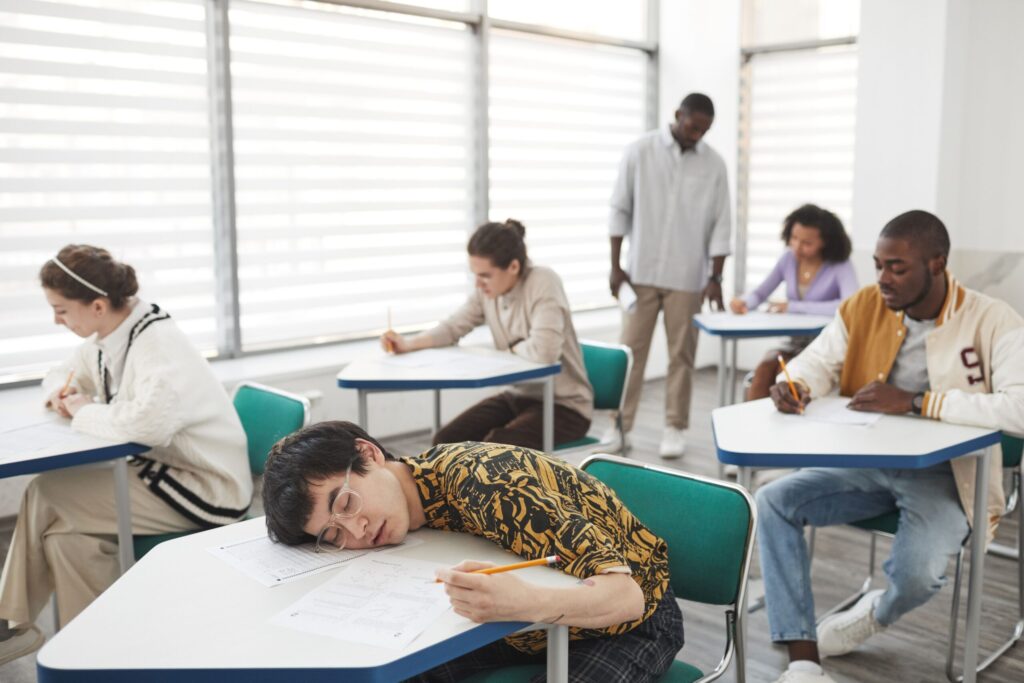

Losing sleep doesn’t just make you tired – it measurably lowers GPA. Research tracking college students found that every hour of sleep lost below eight hours a night is associated with roughly a 0.07-point drop in cumulative GPA, and chronic sleep deprivation raises the odds of failing or withdrawing from a course by about 12%. For students chasing scholarships with a 3.0 GPA cutoff – which is most of them – that’s not an abstract wellness statistic. That’s the difference between qualifying and not.
Let’s talk about something nobody on a scholarship blog usually connects: the science of sleep, and what it’s quietly doing to your actual eligibility.
Quick Facts
| Finding | Detail |
| GPA cost per hour of lost sleep | ~0.07 points below the 8-hour baseline |
| Increased risk of failing/withdrawing from a course | ~12% with chronic sleep deprivation |
| First-year students affected more | 15% more likely to see academic decline with poor sleep |
| When sleep matters most | Early in the semester — it predicts GPA weeks later |
| Peak cognitive window | Roughly 90–120 minutes after waking |
| Most common scholarship GPA cutoff | 3.0 |
The Research Nobody’s Connecting to Scholarship Season
A team led by Carnegie Mellon’s David Creswell ran one of the first studies to track this properly. They measured how much sleep first-year college students got in the first few weeks of a semester, then checked their GPA at the end of term – five to nine weeks later. The amount of nightly sleep a first-year student got at the start of the term predicted their GPA at the end of it, weeks before final exams even happened. Sleep debt isn’t something that catches up with you the night before a test. It’s compounding for weeks before you ever notice the effect.
Separately, broader research pooled across thousands of students found the relationship holds at scale: each hour of sleep lost below eight hours per night is linked to about a 0.07-point drop in cumulative GPA, and chronic sleep deprivation raises the likelihood of failing or withdrawing from a course by around 12%, with first-year students about 15% more likely to see a significant academic decline when their sleep quality is poor.
Here’s the part that should actually change how you think about scholarship season: most major scholarships use GPA as a hard eligibility cutoff, not just a competitive factor. The Coca-Cola Scholars Program requires a minimum 3.0. So do most of the Top 30 Undergraduate Scholarships in the United States we’ve covered. If a student is sitting right at 3.0 during the exact semester they’re gathering transcripts for an application, two or three months of bad sleep is a plausible, measurable reason they might fall under it — not because they got less capable, but because their brain was running on a deficit.
Application Season Decision-Fatigue Problem
This is where it gets interesting, because sleep debt isn’t the only cognitive cost stacking up during scholarship season and this second piece rarely gets talked about at all.
Applying to scholarships means making dozens of small, effortful decisions in a short window: which programs to prioritize, which prompt angle to take, which achievements to lead with, how to phrase a sentence for the fifth time. Psychologists call the decline in decision quality that comes from making too many choices in a row decision fatigue, and research on cognitive performance shows most people’s peak focus and decision-making window sits roughly 90 to 120 minutes after waking, with quality declining as the day goes on.
Put those two findings together and you get a pattern that’s specific to scholarship applicants, not just students in general: the highest-stakes writing of the entire process – the personal essay – is disproportionately written late at night, close to a deadline, by someone running a sleep deficit, during the exact hours when decision-making is weakest. That’s not a motivation problem. That’s a scheduling problem with a biological explanation.
If you are working through our guide to writing a scholarship essay that gets you selected, the single highest-leverage change you can make isn’t a better opening line — it’s moving the writing session to the morning, on a night where you actually slept.
What To Actually Do With This
- Protect sleep specifically during the weeks you’re building your application, not just the week before a deadline. The research shows the damage compounds early.
- Write your essay drafts in the morning, ideally within the first two hours of waking, when decision quality is highest.
- Don’t finalize an essay at 1am the night it’s due. If you only have late hours available, use them for lower-stakes tasks — formatting, gathering documents — and save the actual writing for a rested morning.
- If your GPA is hovering near a scholarship’s cutoff, treat sleep as part of your application strategy, not a separate wellness issue. It is, functionally, part of your application strategy.
A few tools that make this easier to actually stick to:
- A sunrise alarm clock that wakes you gradually with light instead of sound, which helps you actually use that 90–120 minute peak-focus window instead of groggily missing it
- Blue-light blocking glasses for the inevitable late-night screen time during research or form-filling, since evening light exposure is one of the biggest disruptors of the sleep you’re trying to protect
- A white noise machine if you’re a dorm or shared-space student whose sleep gets interrupted by noise you can’t control
- A simple sleep tracker if you want actual data on your own patterns during application season rather than guessing
This post contains affiliate links. If you make a purchase through one, Lantern Post may earn a small commission at no extra cost to you.
More on This from Lantern Post
We’ve actually covered pieces of this puzzle before without ever connecting them to scholarship season directly – worth a read if this resonated:
- Teens Are Staying Up Late on Their Phones and It Could Be Harming Their Health
- Can Coffee Fix Sleep Deprivation? Scientists Say Yes
- 7 Night Habits That Quietly Hurt Your Heart
- Your Sleep Could Be Warning You About Dementia Years Early
And if you’re building toward a specific application right now, our Education section has what’s currently open.
Frequently Asked Questions
1) Does sleep actually affect GPA, or is this just correlation?
The strongest evidence comes from studies tracking sleep at the start of a semester and GPA at the end of it, which shows sleep predicting later academic outcomes rather than just moving together with them. Researchers note that sleep is closely tied to learning and memory consolidation, which gives a plausible mechanism beyond simple correlation.
2) How much sleep should a student get to protect their GPA?
Most of the research uses eight hours as the baseline, with GPA cost accumulating for every hour below that.
3) When is the best time to write a scholarship essay?
Morning, ideally within the first couple of hours after waking, when decision-making and focus are typically at their peak for most people.
4) Can catching up on sleep on weekends fix the damage?
The research on this is limited, and sleep scientists generally caution against relying on weekend catch-up sleep as a substitute for consistent nightly sleep, since it doesn’t fully reverse the accumulated effects on mood, attention, and metabolic health.
5) Is this only relevant to first-year college students?
No – the first-year effect is strongest partly because of the transition stress involved, but the underlying sleep-and-cognition relationship applies to high school seniors building applications and upperclassmen maintaining GPA for renewal scholarships too.